The future-proof design system
Made for
The future-proof design system
Location
Dubai, UAE
Year
2026
what it is
Cabbin is an invite-only, aviation-inspired marketplace. I’m using AI to vibe-code the whole product, from concept to shipped MVP. You can read all about it in my Cabbin Case Study. But Cabbin is also an experiment: Could I build a genuinely design-forward product without designing the entire thing first (and evolve its design system at the same time)?
I wanted to spend less time designing screens in Figma and more time designing the system that could produce those screens well. That became an exercise in systems thinking, product judgment, design governance, AI fluency and process design. The experiment: build the smallest possible system capable of supporting the next product decision, then let real product usage evolve that system, through an AI workflow.
The conventional design system story tends to look something like: define → design → build → extract → document → maintain.
Or, at the other extreme: Prompt AI → generate UI → fix the mess later.
But I wanted neither; I wanted a workflow where the product and its design system could evolve together. The result is a design system that grows alongside the product, and vice-versa.
ARCHITECTURE IS KING
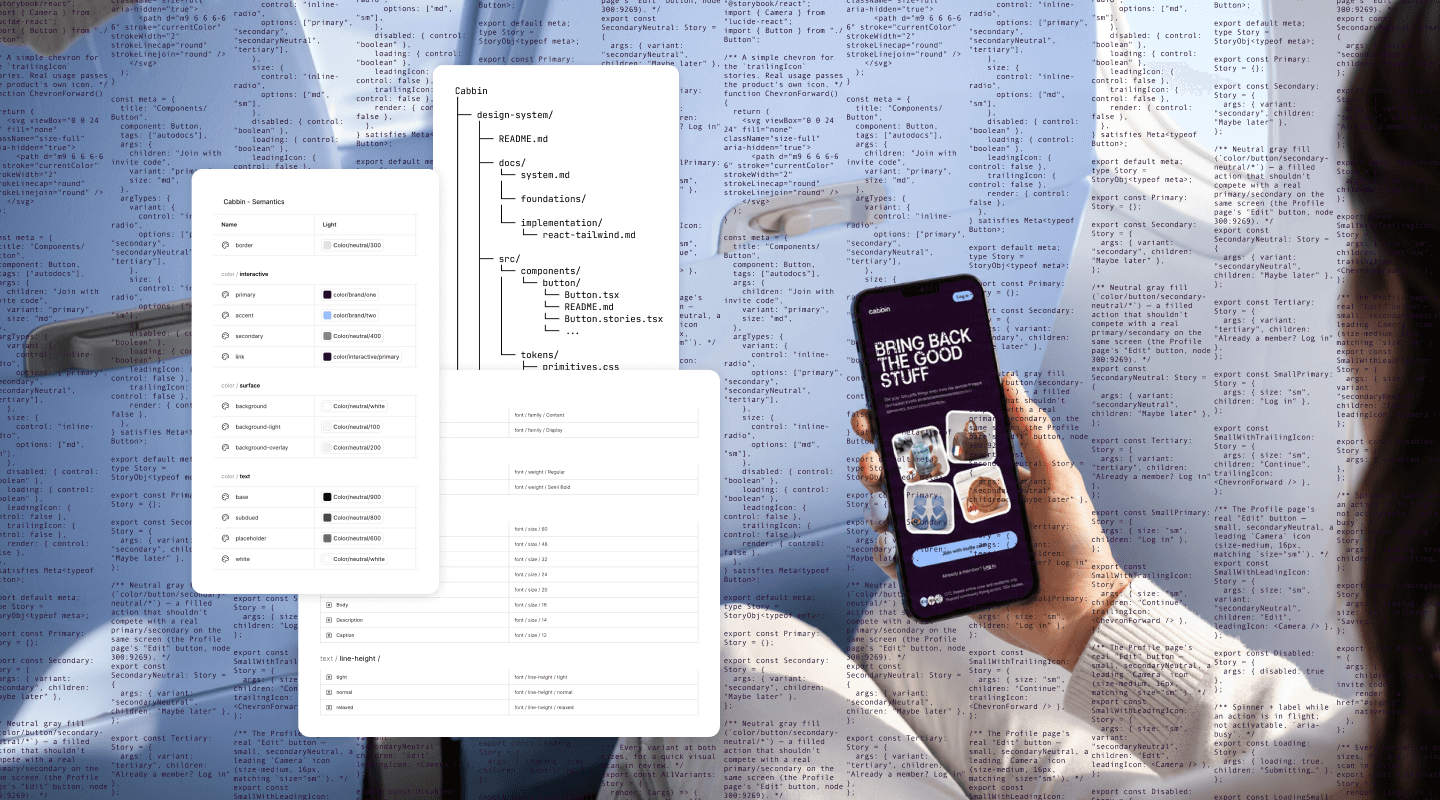
For the workflow I had in mind, I had to find a way for the project to remember itself. So I made a workspace with two sibling repositories:
cabbin-ds: the reusable design system.
cabbin-app: the actual Cabbin product.
The app then consumes the design system as a dependency, creating an intentional gate: a component has to exist, be documented and be human-reviewed in the design system before the product can use it. Each repository also has an AGENTS.md: a tool-agnostic instruction layer that tells an AI agent how the project works. Cabbin-ds includes supporting documentation covering component authoring and token architecture. Cabbin-app holds product specs, UI patterns, and sprint planning. So the documentation is part of the architecture itself.
Also, I wanted my system to survive the tools used to build it. That meant separating design system decisions from implementation details. The token pipeline is also intentionally platform-agnostic: Figma Variables → DTCG JSON → Style Dictionary → CSS/Tailwind.
The components are React-specific because Cabbin is a React product. But the design decisions underneath them don't need to belong to React or to any particular AI agent. If tomorrow's AI tool changes, the system shouldn't have to start over.


THE LOOP I CREATED
It goes something like this: I make the next product/design decision → AI reads the relevant rules and documentation → It checks the existing system → It builds or extends the component (take Google’s Material 3 principles, apply my tokens, use Base UI, use Lucide icons, implement React + Tailwind component) → It documents the change → It composes the component into the product → Automated checks run → I inspect the result in Storybook and the real browser → I give targeted feedback → AI fixes the underlying cause → PR → CI → merge → next sprint
The component stays in-review until I approve it. This creates a continuous feedback loop: the product continuously stress-tests the design system and the design system continuously constrains the product.
A SELF-EVOLVING CONSTITUTION
Whenever the project exposes a gap, I turn the gap into a rule. For example, a token missing from Figma became a Figma backfill ledger; a security issue became a requirement for security audits at the end of every sprint; repeated product decisions became documented UI patterns. The principle is simple: if the system doesn't know how to handle something, we fix the system. Whenever something went wrong, I could ask: “why did this happen?”. If the answer was “because the system doesn't have a rule for this”, then the fix becomes: new system rule → documentation → future enforcement.
WHAT AI DIDN’T DO FOR ME
This part here is my actual manifesto. Everyone knows AI is excellent at local consistency. Once a rule is clear, AI can apply that rule relentlessly: implementing components and states, creating the .tsx, Storybook story, tests and documentation, running type checks, linting, unit tests, migration checks and builds, debugging (tracing implementation problems back to their source). And sometimes it catches things I didn't ask for or have no idea about: my AI agent is a great second pair of technical eyes.
But AI definitely didn’t design the product for me. It can make a super good component, but it doesn't necessarily know whether the component should exist.
My highest-value contribution remained: information architecture (what’s the user’s mental model?), cognitive load (what can we remove?), product policy (is a declined application the same as a ban?), responsive behavior (what should the mobile experience actually be?), interaction heuristics (what’s an error, or a warning, or neither?), system strategy (should a missing token become a new token, an existing token, or a change to the underlying scale?). I found AI is strongest below the level of judgment.
MYSELF: intent, constraints, product policy, UX rationale, design knowledge, system-level trade-offs, approval.
AI: implementation, consistency, repetition, documentation, testing, investigation, speed.
I like this division of labour. The designer's role moves up the abstraction stack: instead of spending most of my time manually drawing every state, I'm spending more time defining the system that determines how those states should be created.
YET TO BE SEEN: RISKS TO MITIGATE
The system can become too specific to Cabbin. Every new product requirement adds to the design system, so the system can slowly become a catalogue of historical requests. That's why every new component begged the question: is this a reusable design decision, or just a solution to today's problem?
Figma falls behind code. In my workflow, a token can exist in implementation before it exists in the visual source of truth. My project does have an explicit mechanism for tracking this “debt” (a Figma backfill ledger). But is it even necessary anymore?
AI can make a bad decision very consistently. That's why the governance layer matters so much.
The system hasn't been stress-tested by another product. I cannot yet claim that it is truly platform-agnostic or broadly reusable. However, it is architected toward portability, and it is Cabbin's design system after all.


NOT REVOLUTIONARY, BUT PRETTY AWESOME
Component-driven development, design tokens, isolated component development, governance and real-product feedback: these are all established design system practices. But what I set out to do was to build a product from scratch, without an engineering team, while deliberately avoiding a fully designed product upfront. I’m building the product and its design system simultaneously, with AI acting as the implementation engine and the design system acting as the constraint/governance layer. For me, that's the interesting future of AI-native product design: less time producing every interface artifact in advance, more time designing the rules, relationships and constraints that allow the interface to evolve coherently. The AI can turn a relatively small design decision into a working implementation, the product can immediately test whether that decision survives real usage, and the design system can evolve from evidence.
The Design System is being designed by the product — with a human still firmly in charge of deciding what the product should become.


